To move beyond a functional but generic wardrobe, you do not need to replace your reliable basics. The most effective method is to define your aesthetic with a few personal keywords, then use them as a filter to introduce a small number of expressive pieces (items with unique color, texture, or silhouette) that work with what you already own. This approach adds personality and multiplies your outfit combinations without creating a cluttered closet.
Find your style keywords
Before buying anything new, the first step is to analyze what you already like. A personal style is a pattern of preferences that you can discover and articulate. Having clear keywords to describe this pattern provides a framework for every decision, from editing your closet to choosing new items. The goal is to develop a filter that separates what you genuinely like from what is just a passing trend or a habit.
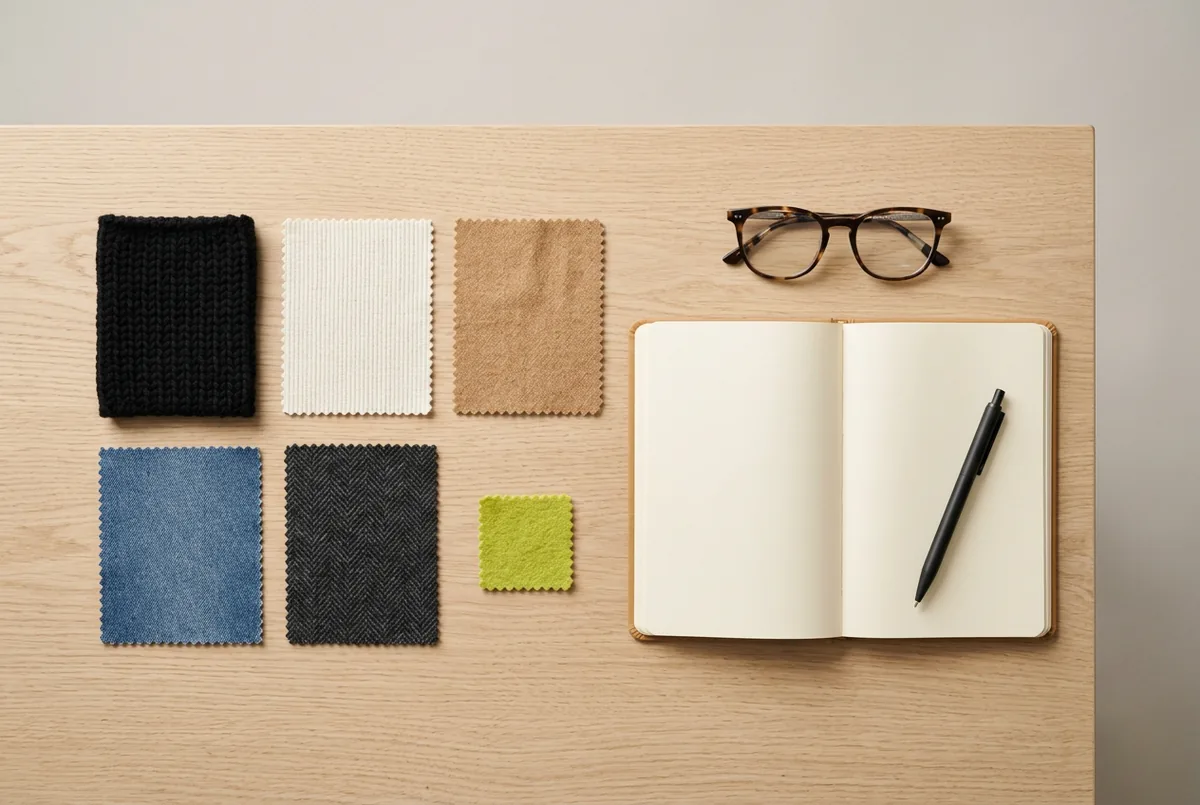
Start by looking for recurring themes in clothes, images, and objects you are drawn to. Look through your existing wardrobe for the pieces you wear most often. Go beyond function and ask why you reach for them. Is it the fluid drape of a rayon blouse, the sturdy feel of heavy cotton twill, or the sharp line of a tailored shoulder? Then, look at saved images online, characters in movies, or art and architecture. Collect these in a private place, like a folder on your computer or a physical corkboard. It is not about finding outfits to copy, but about identifying a consistent mood.
Once you have a collection, describe it with three to five adjectives. These are your style keywords. They might be about texture (“textured,” “smooth,” “raw”), silhouette (“structured,” “draped,” “oversized”), or overall feeling (“minimalist,” “preppy,” “earthy,” “dramatic”). These words are your guide. For example, if your keywords are “structured, minimalist, neutral,” a sculptural black jacket would be a better fit than a floral peasant blouse, even if you like them both in theory.
The 80/20 rule for a wardrobe with personality
A functional wardrobe that also feels personal often follows an unwritten 80/20 rule: about 80% are versatile, core basics, and about 20% are expressive pieces that give the basics a point of view. If your closet is full of reliable neutrals, you already have the 80%. The task now is to find the 20%.
An expressive piece is not necessarily loud or difficult to wear. It is an item that has one or two distinct features that set it apart. It could be:
- A unique color: Instead of another navy sweater, one in cobalt blue or burnt orange.
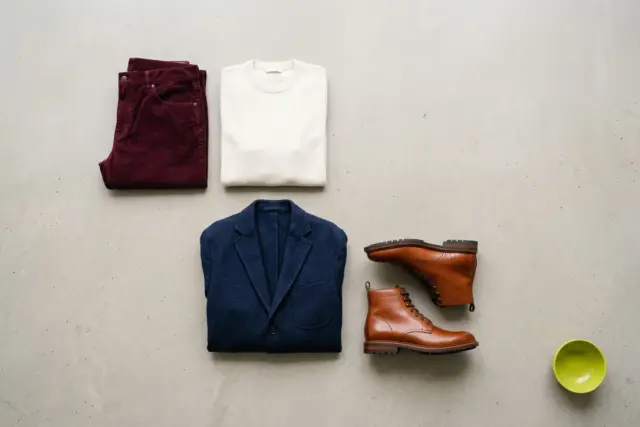
- A noticeable texture: A chunky fisherman knit sweater, a pair of corduroy pants, a silk-velvet blazer, or a raw silk shirt.
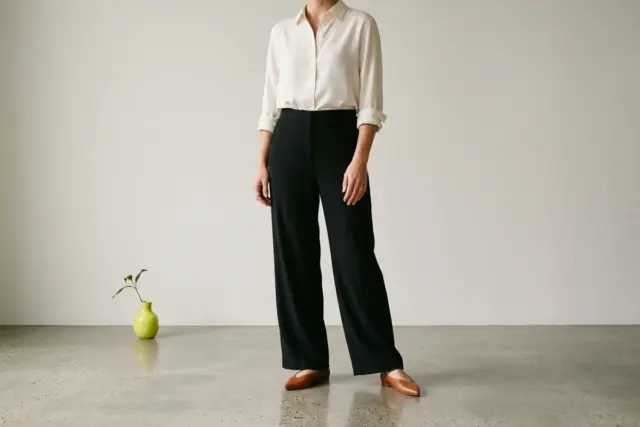
- An interesting silhouette: A top with a boat neck or bishop sleeves, wide-leg trousers, or a coat with a strong shoulder line.
- A thoughtful detail: A trench coat with a contrasting collar, loafers with a lug sole, or a button-down shirt made from an unusual fabric like washed linen.
The key is that these pieces should still connect to your core wardrobe. That burnt orange sweater works because it can be worn with your existing dark-wash jeans, grey wool trousers, and khaki chinos. The goal is to find pieces that are both interesting on their own and compatible with the simple, functional clothes you already rely on.
How to add expressive pieces without cluttering your closet
Adding expressive items requires a clear decision-making process to ensure they integrate into your wardrobe instead of becoming isolated orphans. An impulse buy can easily become clutter if it does not work with your life or your other clothes. Before purchasing a new statement piece, run it through a mental checklist to test its potential.
This checklist acts as a practical guardrail. For example, you might find a beautiful, brightly colored silk shirt. It fits your keywords (“fluid, colorful, refined”). But if your daily life involves toddlers or you are not prepared to hand wash or dry clean it, it is not a practical choice. Similarly, a pair of architectural, wide-leg trousers might seem perfect, but if they only work with one pair of shoes you own and a single top, they fail the versatility test. A truly successful expressive piece is one you can wear as easily as your favorite t-shirt.
See how a few pieces can transform a basic wardrobe
Adding just a handful of strategic, expressive items can dramatically increase the number of available outfits from a core set of basics. It is a matter of multiplication, not just addition. The more versatile pieces you have, the more combinations each new item can create.
Consider a small capsule wardrobe of 11 reliable items: 5 tops, 3 bottoms, 1 dress, 1 layering piece, and 2 pairs of shoes. Assuming most pieces work together, this small collection already yields dozens of outfits.
Using the calculator, a wardrobe of 5 tops, 3 bottoms, 1 dress, 2 pairs of shoes, and 1 layer gives you 64 possible outfits. Now, let’s see what happens if you thoughtfully add just three expressive pieces: one top (bringing the total to 6), one layer (total of 2), and one pair of shoes (total of 3). The total number of outfits jumps from 64 to 171. You have more than doubled your options by adding only three items. This demonstrates why choosing new pieces based on how they integrate is more powerful than buying whole new outfits. For more on building that initial foundation, see our guide on how to build a fall capsule wardrobe.
What not to do when evolving your style
As you move from a basic wardrobe to one with more personality, some common missteps can lead to frustration and wasted money. Avoiding them is as important as finding the right pieces.
First, avoid buying a complete, pre-styled “look.” When you see an outfit on a mannequin or online and buy all the components, you often end up with pieces that do not work with the rest of your closet. The goal is to buy individual garments that are versatile enough to be woven into many different combinations. An expressive piece should be a bridge, not an island.
Second, learn to distinguish between a trend and a genuine personal preference. A silhouette or color might be popular for a season, but if it does not align with your style keywords or feel authentic to you, it will likely feel dated or out of place in your wardrobe next year. Refer back to your mood board and keywords. If a new piece fits that long-term vision, it is style. If it only fits what you have seen in stores for the last two months, it is probably a trend.
Finally, do not compromise on fit and fabric quality for the sake of an interesting design. An ill-fitting garment in a cheap, pilling fabric will never look intentional, no matter how unique its design. The most expressive pieces are often those where a simple silhouette is rendered in a beautiful material that drapes or holds its shape perfectly. Pay attention to shoulder seams, fabric content, and how a garment feels when you move. These fundamentals are what make any style, basic or bold, work.
Read next