In this guide (6)
Pair a quarter-zip sweater with either a button-down collar dress shirt tucked cleanly inside the sweater neckline or a dense, high-crewneck t-shirt that stays flat against the throat. A soft, unstructured spread collar collapses behind the brass teeth of the zipper, while a thin, ribbed undershirt looks like sleepwear peeking through an intentional knit. The zipper opening sets the visual boundary. Unzip the metal pull enough to let the collar points rest comfortably inside the knit collar band. When wearing a crewneck t-shirt, unzip the pull slightly above the collarbone, creating a clean sliver of cotton that frames the neck without exposing bare skin.
The collar rule for woven dress shirts
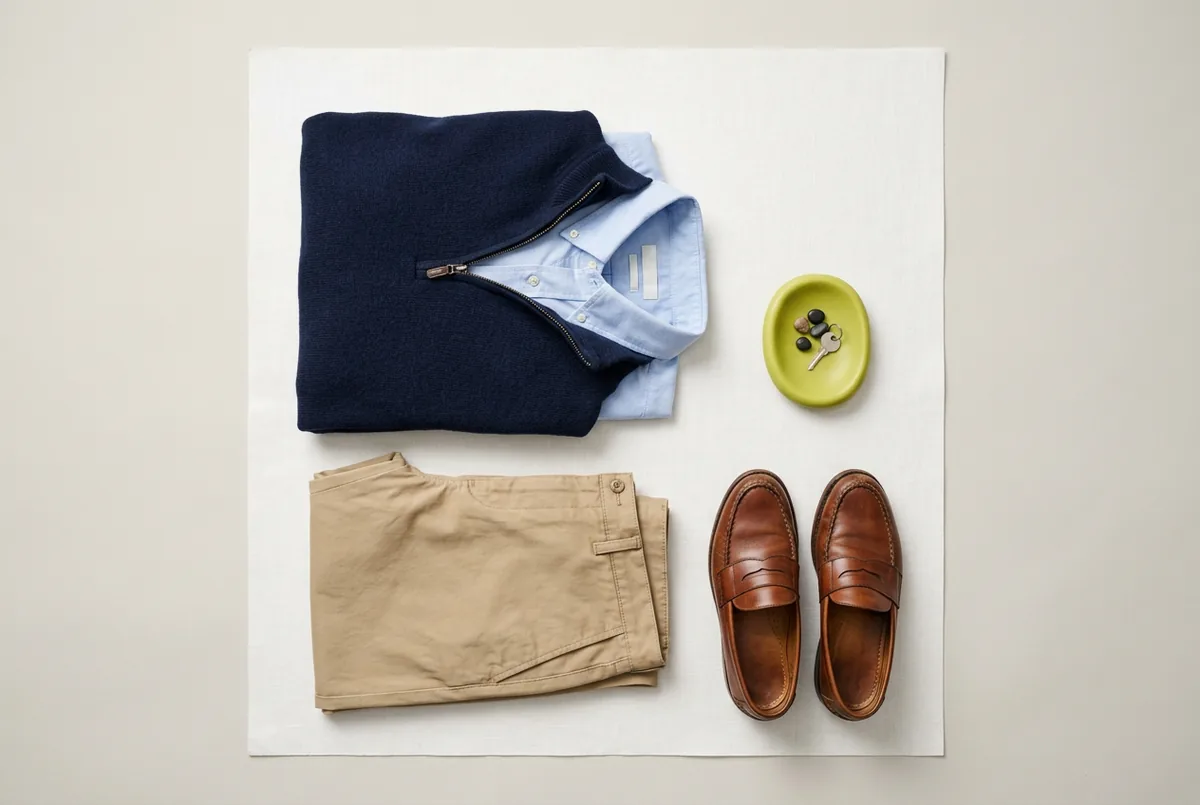
A quarter-zip sweater has an upright, tubular collar band that holds its own shape around the throat. When you wear a woven shirt underneath, you are placing one collar inside another. If the inner collar lacks structure, the weight of the knit sweater crushes it, forcing the shirt points into an uneven, crumpled mess behind the zipper track.
An oxford cloth button-down collar solves this mechanical clash completely. The tiny buttons on the shirt points anchor the collar tips firmly against the shirt front. Because the tips cannot migrate, the collar arches upward in a clean roll that peeks just above the sweater rim without fighting the zipper. If you prefer a smooth dress shirt without collar buttons, ensure the collar has stiff sewn-in or metal stays. Even with stays, an open spread collar often splays outward when unzipped, catching on the zipper teeth.
Keep the collar tips inside the sweater at all times. Folding your shirt collar points over the top of the knit sweater collar looks dated and sloppy. It creates an awkward wing effect that breaks the clean vertical line of your torso. For the rest of the shirt build, double-check what to check on a men’s dress shirt before layering, particularly the neck and shoulder measurements.
Why ordinary undershirts destroy the neckline
The most common mistake with a casual quarter-zip is wearing a standard ribbed undershirt beneath it. Undershirts are designed as underwear. They use lightweight, stretchy cotton and thin, narrow collar bands that ripple or sag after two trips through the laundry. When you unzip your sweater, that wavy collar band signals to everyone in the room that your base layer was an afterthought.
A base layer t-shirt must be an actual outerwear t-shirt made from substantial cotton jersey. Look for a dense fabric weight with a thick, tightly bound crewneck collar that hugs the base of your neck without stretching out. A bright white or heather gray crewneck collar provides a deliberate athletic contrast against dark navy, charcoal or forest green knitwear.
Avoid v-neck undershirts when wearing an unzipped quarter-zip. A v-neck drops down toward the sternum, leaving an empty triangle of bare skin and chest hair visible between the open zipper tracks. In an office setting or across a dinner table, that flash of bare throat looks incomplete and disheveled. If you want no base layer visible at all, zip the sweater all the way up to mid-neck, or choose a deep v-neck only when keeping the pull fully closed.
Managing fabric bulk around the torso and waist
Knitwear clings slightly to whatever sits beneath it. A fine-gauge merino wool or cotton-cashmere quarter-zip reveals every pleat, wrinkle and pocket flap of a bulky base layer. Layering requires matching fabric weights from light to heavy, starting closest to your skin.
Under fine-gauge sweaters, wear lightweight cotton poplin, pinpoint oxford or smooth jersey tees with no chest pockets. Reserve heavy flannel shirts, corduroy button-downs or thick waffle thermals for chunky, ribbed wool sweaters with substantial heft. If the sweater fabric is thinner than the shirt beneath it, the placket buttons and chest seams will emboss right through the knit front.
Hem length matters just as much as fabric weight. When you wear a button-down shirt under a quarter-zip, tuck the shirt tails completely into your trousers. A curved dress shirt tail poking out beneath the ribbed bottom waistband of a sweater cuts your legs in half visually, distorting your proportions. If you are wearing a crewneck t-shirt on the weekend, the t-shirt hem must remain shorter than the sweater waistband, or you should tuck it neatly into your jeans.
Do
- Tuck shirt collar points securely inside the knit collar band
- Fasten collar buttons on oxford shirts to hold the roll in place
- Tuck dress shirt tails into your trousers to prevent hem bunching
- Choose dense crewnecks with a flat, tight collar band
Avoid
- Fold shirt collar wings outside over the sweater ribbing
- Wear thin ribbed undershirts with stretched, wavy necklines
- Layer heavy flannel shirts under thin merino wool pullovers
- Let curved woven shirt tails hang beneath the sweater waist
A smart casual office formula with tailored trousers
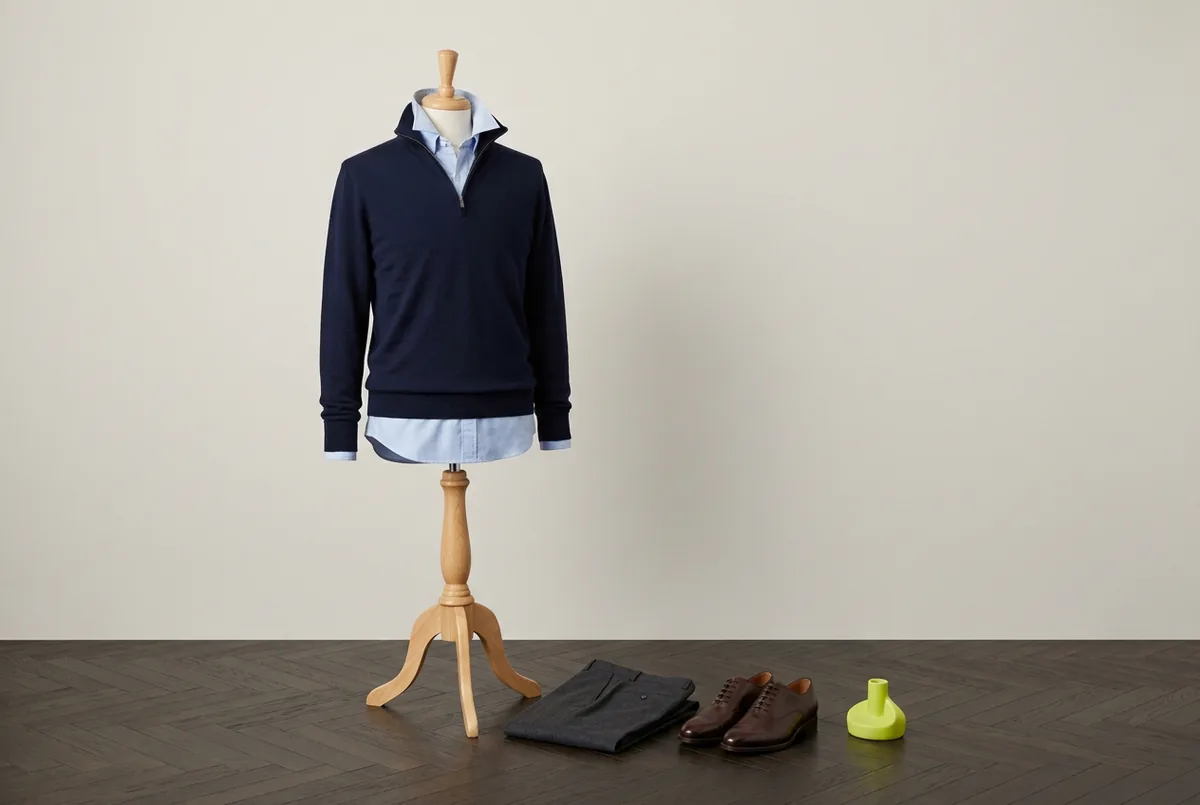
In an office environment with a smart casual dress code, a quarter-zip bridges the gap between a formal tailored jacket and an informal long-sleeve tee. Navy and charcoal remain the most functional colors because they coordinate easily with classic office trousers while disguising subtle fabric friction.
Keep the accessories understated and the textures complementary. A smooth merino wool knit balances the dry, matte hand of wool flannel or worsted wool trousers. Dark brown leather shoes ground the outfit without the stark rigidity of black dress oxfords.

A casual weekend formula with dark denim
For weekends, road trips or casual dinners, swap the woven button-down shirt for a heavyweight cotton crewneck t-shirt. An oatmeal or heather beige sweater paired with crisp indigo denim introduces warmth and texture without feeling rigid. When heading out into changing temperatures, follow the system outlined in how to layer for fall by topping this pairing with an unlined wool overcoat or field jacket.
The zipper on a weekend knit should sit slightly lower than in the office, opening just enough to display the clean white band of the crewneck flat against the base of the throat. Sturdy leather boots anchor the heavy denim and keep the lower half proportionate to the layered knitwear above.
When to skip the quarter-zip entirely
A quarter-zip is a hybrid garment, which means it fails whenever an occasion demands clear-cut formality. Never wear a quarter-zip with a necktie. Stuffing a silk necktie knot inside a zipped metal collar creates an uncomfortable bulge at the throat, and pairing a sporty brass or nylon zipper with silk creates a jarring conflict of formality levels. If an event requires a tie, reach for a tailored blazer, a v-neck merino sweater or a button-front cardigan instead.
Indoor climate control also dictates whether this knit makes sense. A quarter-zip functions as a mid-layer that is awkward to take off in public. Pulling a sweater over your head in a meeting dishevels your hair and pulls your shirt collar out of alignment. If your office runs hot and you suspect you will need to strip down to your base layer, wear a cardigan with a full button placket or a light sports coat instead.
Finally, inspect the collar stand itself before getting dressed. If repeated washing or improper drying on wire hangers has stretched the sweater neck into a floppy, wavy funnel, retire the piece. A quarter-zip relies entirely on collar tension to look sharp. Once the ribbed stand loses its memory and droops around your jawline, no base layer in your closet can rescue the silhouette.
Read next