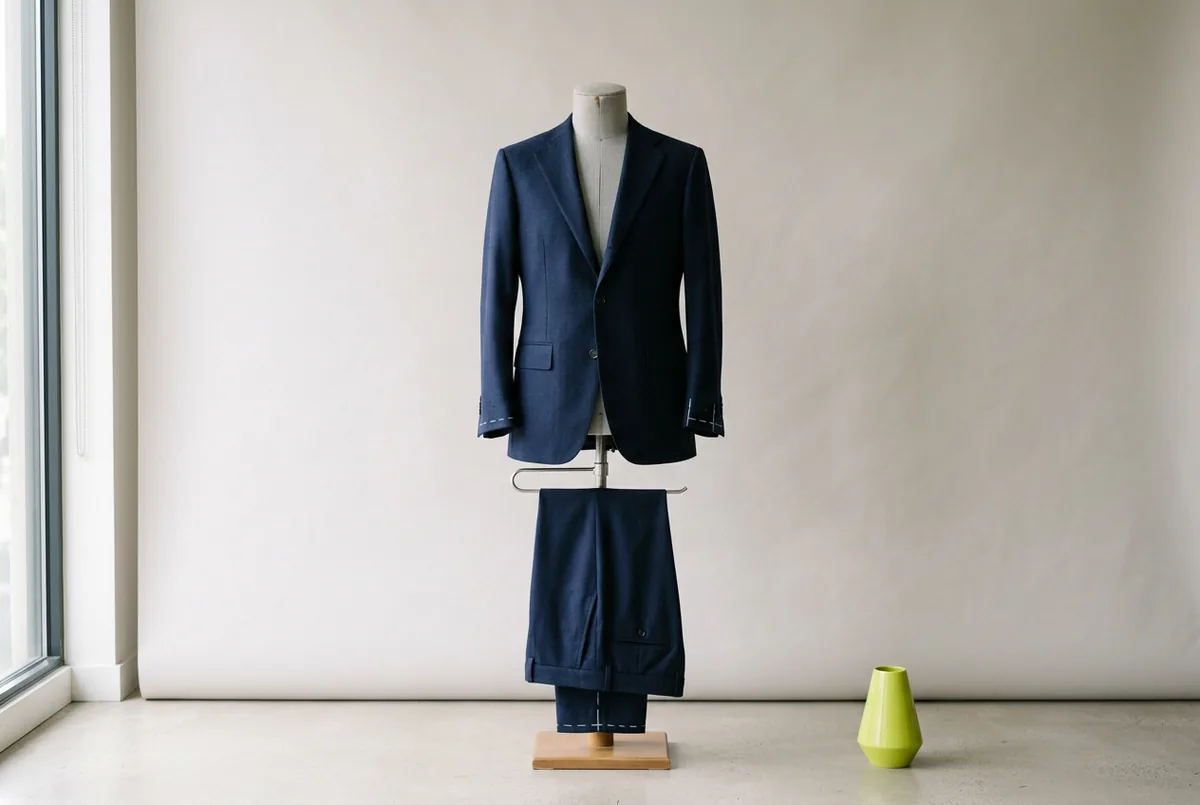
A suit that fits correctly starts with the shoulders. The jacket’s shoulder seams must sit squarely on the edge of your shoulder bones; if they are too wide or too narrow, the suit is not your size, and this is the one part a tailor generally cannot fix. From there, a proper fit means the jacket buttons without pulling and the trousers fall in a clean line. Nearly everything else, from sleeve length to the trouser waist, can be adjusted by a tailor to create a sharp, comfortable silhouette for work, weddings, or any formal occasion.
How to check the fit of a suit jacket
When trying on a suit jacket, wear the kind of dress shirt you would normally pair with it. The fit across the shoulders is your first priority. Unlike adjusting a waist or sleeve, rebuilding a jacket’s shoulders is complex, expensive, and often not worth the cost. If the shoulders do not fit off the rack, you should try a different size or brand.
Once the shoulders are right, fasten the top button (on a two-button suit) or the middle button (on a three-button suit). The jacket should close without creating a stressed ‘X’ shape with the fabric. The lapels should lie flat against your chest. You should be able to slide one hand flat between the buttoned jacket and your chest with little resistance. If you can fit a fist, it is too loose. This simple test ensures the jacket is fitted to your torso without restricting movement.
Jacket sleeve length is a matter of proportion. With your arms relaxed at your sides, the jacket sleeve should end around your wrist bone, revealing a small band of the shirt cuff. This creates a clean visual transition from the suit to the hands. Finally, check the jacket’s length. A traditional suit jacket should be long enough to cover the seat of your trousers. Shorter jackets exist, but the classic length ensures the jacket balances the lower half of your body.
How to check the fit of suit pants
Suit trousers should be comfortable at the waist and drape cleanly down your leg. The waistband should sit securely at your natural waist or slightly below it, depending on the rise of the pants, and you should not need a belt to hold them up. If the waist is too loose or tight, a tailor can easily adjust it.
The fit through the seat and thigh is next. The fabric should follow the line of your body without pulling tight across your seat or thighs when you stand, walk, or sit. You will know the fit is wrong if you see horizontal stress lines when standing or if the pockets flare out. On the other hand, excessive, baggy fabric will bunch and fold, breaking the clean vertical line.
The length of your trousers, known as the “break,” is where the hem meets your dress shoes. This is a personal preference, but a slight or quarter break is the contemporary standard. This means the trouser hem grazes the top of your shoe, creating one small horizontal fold in the fabric. A no-break style, where the hem just kisses the shoe with no fold, offers a sharp, modern look, especially with slimmer-cut trousers. A full break, with a deeper fold, is more traditional but can look out of place if not handled well. For most situations, a slight break is a reliable choice.
What to ask your tailor (and what they cannot fix)
Once you have found a suit that fits well in the shoulders, it is time to visit a tailor for refinements. Communicating clearly what you need is simple. Use the fit checklist tests to show them where adjustments are needed. These alterations are routine for any competent tailor:
- Adjusting the trouser hem: This is the most common alteration. Wear the dress shoes you plan to wear with the suit when you go for your fitting.
- Taking in or letting out the jacket waist: This creates a fitted shape around your torso.
- Taking in or letting out the trouser waist and seat: For a clean fit that is comfortable when you sit and stand.
- Shortening or lengthening the jacket sleeves: This is done from the cuff to get the length just right. Lengthening is only possible if there is extra fabric inside the sleeve.
Some alterations are much more difficult and costly. As mentioned, altering the shoulders is major surgery for a jacket. Changing the jacket’s overall length or the rotation of a sleeve are also complex jobs. It is almost always better to find a suit that gets these fundamental points right from the start.
A complete look: the well-fitted suit in action
A well-tailored suit is a versatile foundation. For business formal settings, weddings, and other important events, a classic two-piece suit in navy or charcoal is a reliable choice. The fabric, however, must suit the climate. While a mid-weight wool suit is a standard for most of the year in many parts of the US, it would be uncomfortable in the humid South or dry Southwest during the summer. In those conditions, look for suits in lighter, more breathable fabrics like linen, cotton, or tropical-weight wool. The fit does the work, allowing simple, high-quality pieces to complete the look. The goal is to create a cohesive silhouette where no single element distracts from the whole.
The same principles of fit apply whether you are wearing a full suit or breaking it up into separates. A perfectly tailored suit jacket can also serve as a standalone blazer with chinos or dark jeans for a smart casual occasion. For more ideas on less formal outerwear, see our practical guide to choosing and styling a man’s light jacket.
Caring for your tailored suit
Once your suit is tailored, proper care will protect the garment. Most suits are made of wool, which does not need frequent cleaning. Simply hanging your suit on a proper wishbone-shaped hanger after wearing allows the fibers to relax and odors to air out. Brush it occasionally with a soft-bristled clothes brush to remove dust and surface dirt.
When it does need cleaning, check the care label. If it says “Dryclean Only,” that is a warning that washing in water will damage the garment’s internal structure, like fusing or padding. If the label just says “Dryclean,” that is the one safe method the manufacturer guarantees. For a wool suit, pressing with steam or a medium-heat iron with a damp press cloth can refresh it between cleanings. Never put a wool suit jacket or trousers in a washing machine or dryer, as the combination of heat and agitation can cause the wool to felt and shrink permanently.
| Care | Wool |
|---|---|
| Washing | Hand wash cold with wool detergent, or the wool cycle |
| Drying | Flat, never hanging |
| Ironing | Steam, or medium heat with a damp press cloth |
| Watch out | Heat plus agitation shrinks it for good (felting) |
Read next